
Why Your Focus Time Is Vanishing (And the Numbers Behind It)
Let's start with a number that should bother you: the average knowledge worker loses roughly 2.1 hours a day to context switching, according to a widely cited University of California, Irvine study. That's not a productivity myth; it's a measured toll. Every time you bounce from Slack to email to a half-finished report, your brain needs up to 23 minutes to fully re-engage with the original task. Multiply that across a week and you're throwing away nearly an entire working day. Deep work isn't a lifestyle trend — it's the only reliable countermeasure when your calendar is a pile of hyperlinks and your inbox keeps pinging at 40-second intervals. The methods below are the ones I've seen survive contact with real deadlines, real teams, and real interruptions.
The 10-Minute Re-Entry Problem Nobody Mentions
Most people assume the enemy of focus is distraction. In practice, the bigger enemy is the re-entry cost after an interruption. When you get pulled out of a flow state, you don't lose just the minutes you were interrupted; you lose the buildup time it takes to reconstruct your mental model of the task. This is why shallow tasks feel so draining: they never let your working memory settle. A practical fix borrowed from deep work coaches is the "interruption log." For three days, keep a running list of every time you switch tasks, who or what triggered it, and how long it took you to get back to focused work. In my experience, the results are almost always the same: people discover that email and chat account for 70% of their switches, and that recovery time averages 15–20 minutes per switch. That data alone justifies a hard block on notifications during your peak hours. If you want a system to enforce these blocks, the scheduling apps covered in our deep work scheduling apps roundup show which tools actually stick to the plan rather than quietly letting you snooze notifications.
Method 1: Time-Boxed Deliberate Practice
Deep work is often confused with "working long hours." It's not. The stricter definition, popularized by Cal Newport, requires a clear, high-value goal and a distraction-free environment, done for a bounded period. The most useful refinement I've found is to treat each block as a session of deliberate practice: decide in advance what success looks like, set a timer for 60–90 minutes, and refuse any task that isn't the chosen one. The difference between this and a vague "focus block" is that you've pre-committed to a deliverable, which gives you a natural point to stop and review. Over time, you also get feedback: if you regularly finish the intended output in 50 minutes, stretch the scope; if you're constantly falling short, you're either overloading the block or still multitasking inside it. For a full walkthrough of building these blocks into a weekly rhythm, see our guide to deep work scheduling.
Method 2: The Shutdown Ritual That Protects Tomorrow
A subtle cause of poor deep work is unfinished mental loops. Open tabs, unresolved emails, and "I'll just remember that" thoughts all occupy subconscious bandwidth. The fix is a shutdown ritual: at the end of each workday, spend 10 minutes writing down every open loop, organizing tasks by priority, and declaring the workday over. This isn't naval-gazing; research on the Zeigarnik effect shows that incomplete tasks keep nagging the mind until they're either finished or explicitly deferred. The key is that the list becomes your external memory, so your brain finally lets go. People who adopt this ritual report that the first hour of the morning is dramatically more focused, because they're not spending it trying to reconstruct yesterday's scattered intentions. Pair the ritual with a written daily plan, and you've got the core of a sustainable deep work practice that doesn't rely on willpower.
Method 3: Phone-Free Immersion Windows
Your phone is not the villain because it's loud. It's the villain because it's always available as an escape hatch. The moment a task gets hard, the pull of scrolling is strongest. To counter this, schedule specific immersion windows — 90–120 minutes where the phone is in another room, not just face-down on the desk. One trick that works better than an app: a cheap physical timer that forces you to get up and walk to stop it, which inserts just enough friction to make quitting not worth it. If you do use software, choose apps that physically block other apps rather than merely sending reminders. When the tool landscape is cluttered, the focus apps guide for 2026 lists the ones that genuinely lock down distractions instead of giving you a soft nudge.
Method 4: Structured Review — Where Deep Work Actually Compounds
Most deep work advice stops at "block time and eliminate distractions," but the real gains come from review. After each focus session, spend five minutes answering three questions: What did I produce? What got in the way? What should I change tomorrow? This turns deep work from a mood into a measurable skill. Over a few weeks, you'll see a pattern emerge: certain hours are reliably better, certain tools are reliable crutches, and certain colleagues have a gift for interrupting at the worst moments. Use that data to negotiate your calendar. Interestingly, this review step is itself a form of deep work, because it forces you to think critically about your own process rather than just executing tasks on autopilot. For tactical techniques to layer on top, the collection of deep work techniques offers concrete drills you can slot into any method.
Choosing the Right Method for Your Reality
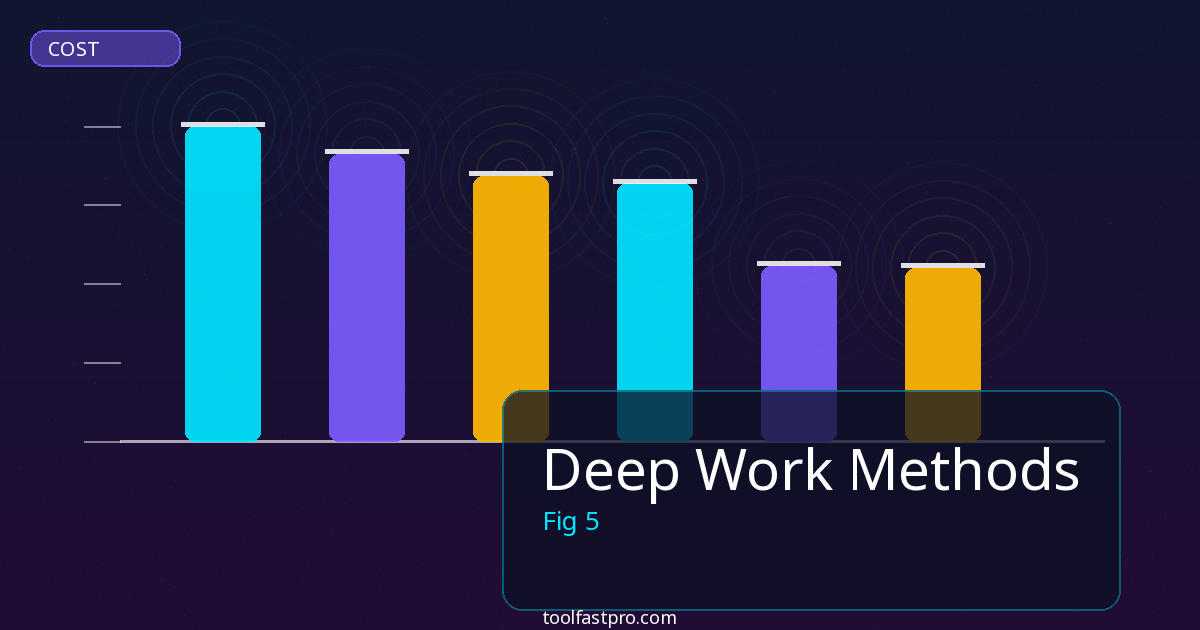
Not all deep work methods suit all roles. A solo writer can lock a morning block and ignore the world; a customer-support manager cannot. That doesn't mean support-heavy roles are doomed to shallow work — it means you need a method built around shorter, protected bursts and clear delegation rules. Below is a comparison of the four methods against the criteria that actually matter: scheduling rigidity, resilience to interruptions, and how quickly they produce visible results.
| Platform / Method | Key Trait | Best For | Cost or Effort |
|---|---|---|---|
| Time-Boxed Blocks | Fixed 60–90 min sessions with a pre-set deliverable | Deep thinkers, writers, developers | Free (just a timer) |
| Shutdown Ritual | 10-min evening loop closure | Anyone with many open tasks | Free (notebook or Notion) |
| Phone-Free Windows | Hard device isolation w/ physical timer friction | Heavy smartphone users | Free; optionally apps like Freedom ($6.99/mo) or Forest ($3.99) |
| Structured Review | 5-min post-session analysis | Anyone aiming to improve over time | Free |
| Focus@Will | Neuroscience-based audio for focus | People who work better with sound | ~$4.17/mo billed yearly |
| Freedom | Cross-device app/website blocking | Self-control challenged users | $6.99/mo or $29.99/yr sessions |
The honest takeaway from the table is that the cheapest methods are often the most effective, because they build discipline rather than dependence on a subscription. Spend money only on the one thing you keep failing at: if you can't leave your phone alone, buy Freedom; if silence drives you crazy, try Focus@Will. Don't buy all of them.
FAQ: Deep Work Methods
How long should a deep work block last when I'm just starting out?
Start at 45 minutes and build up. Most beginners collapse after 90 minutes because they've been multitasking for years. Once 45 minutes feels effortless for a week, push to 60, then 90. The upper limit for most people is around two hours before quality degrades.
Can I do deep work on tasks that aren't creative, like answering support tickets?
Yes, but adjust the definition. For repetitive-but-important work, deep work means grouping it into a single protected block with no interruptions, rather than scattering it across the day. The method that matters here is the shutdown ritual plus time-boxing, not phone-free windows.
What if my manager or coworkers keep interrupting me during my blocked hours?
Communicate the block explicitly and make yourself briefly unreachable. Set your status to "in deep focus," schedule the block on a shared calendar, and agree on a response delay of 30–60 minutes. Most interruptions are convenience, not urgency. If they're genuinely urgent, you'll survive the two-hour hit.
Does deep work help with remote meetings, or only solo tasks?
It helps both, but differently. For solo tasks it's about eliminating distraction; for meetings it's about preparation and follow-through. If your calendar is full of meetings, protect the gaps between them and apply the review ritual to each one so you're not carrying meeting leftovers into your focus time — a habit we cover in the meeting efficiency tools guide.
Making Deep Work Stick Past the First Week
The biggest failure mode isn't starting — it's quitting after day five when the novelty fades. To make deep work stick, anchor it to a recurring mechanism: a fixed start time, a standing calendar event, and a visible streak you'd feel bad breaking. One rule I encourage people to adopt is "no focus, no finish": as long as you've done one honest deep work block that day, the rest of the day is free to be shallow. This removes the guilt loop that makes people abandon the practice entirely. The goal isn't to become a hermit who works in monastic silence; it's to give yourself a few reliable hours a day where genuinely hard thinking happens. That's a skill worth building for a career, and it starts with one honest block tomorrow morning.