
The Focus-Music Sales Pitch That Doesn't Survive Contact With Your Ears
Pick any focus-music playlist and you'll meet the same claim: "engineered to boost concentration." The reality is messier and more useful. Some audio helps you focus; a lot of it just feels nice and does nothing measurable; and some of it actively hurts you, especially music with lyrics or strong emotional pull. The scientific literature is genuinely mixed, in part because "focus" means different things to different people and in part because people self-select the audio they like, which confounds every study. What research does support is more specific than "music helps." The features that matter are tempo, familiarity, lyric content, and volume. This article walks through what the evidence actually says and how to pick tools that work for your specific kind of attention problem — not the kind that works for a YouTube thumbnail.
What the Research Actually Shows About Tempo and Lyrics
Three findings from attention research are consistent enough to build on. First, lyrics hurt reading comprehension and writing — speech-processing competes for the same language resources you need for verbal tasks. Instrumental and ambient tracks are safer for language-heavy work. Second, tempo matters: around 60–80 BPM aligns with resting heart rate and tends to support calm focus, while faster, aggressive tracks raise arousal and hurt sustained attention on novices. Third, familiarity matters more than novelty. Music you've heard before doesn't demand your attention for pattern-recognition, so it leaves more working memory free. This is why the same old playlist beats the trending one. The practical implication: the song choice matters less than the *stability* of the audio — sudden tempo changes, surprises, and vocals are the real focus-killers, not "music" in general. If you want a quick set of vetted, stable tracks rather than building your own from scratch, the collections on focus music playlists save you the curation effort up front.
Lyrics Rule for Verbal Work, Silence Rules for the Rest
If you write, edit, read, learn, or code (which is language-heavy), music with lyrics is the enemy. The mental cost isn't dramatic per track, but it compounds across a day of verbal work. For these tasks, your options in order of decreasing safety are: silence, steady ambient/white noise, instrumental, and only then low-volume lyrics as a last resort. If your work is more visual, spatial, or physical — design mockups, CAD, data sorting, mechanical tasks — the lyric penalty is smaller, and even vocal music can work without a measurable dent. This distinction is the single most useful thing you can take from the research, and it's almost never in the marketing copy of a focus-music app, which has no idea whether you're drafting a grant or retouching photos.
The Tools Landscape: What Each Genre of App Actually Delivers
Focus audio tools fall into a few distinct families, and knowing which family you're buying into prevents a lot of disappointment. The first family is *curated streaming playlists*: Spotify, Apple Music, and YouTube playlists built around "deep focus" tags. These are cheap (possibly free) but uncurated in practice — individual tracks range from great to distracting. The second family is *science-marketed audio apps* like Brain.fm and Endel, which generate audio to match a claimed brain state and cost a subscription. The third is *lo-fi / ambient stations* like Lofi Girl or product rhythm music, which are steady and cheap but repetitive. The fourth is *wearable or hardware solutions* like noise-canceling headphones plus app-controlled music. Each has a different cost structure and a different trade-off between predictability and variety.
Picking by Attention Style, Not by Marketing
Stop choosing a focus-music tool by its logo or its "science" page, and start by diagnosing your attention profile. Ask: am I distracted by *noise* (people talk, traffic, office hubbub) or by *boredom* (my own mind wanders)? If it's external noise, the win is masking: white noise, brown noise, or noise-canceling headphones are the fastest fix, and you don't need a subscription. If it's internal wandering plus verbal work, you need steady instrumental or ambient that minimizes surprises. If you're doing calm, familiar tasks and want mood support, curated lo-fi playlists do more than they're given credit for, and the ready-made collections on focus apps for 2026 mix audio with other proven focus helpers. The wrong pick — say, ambient noise for a spatially bored brain — just adds another layer of nothing. A framework to decide is where the focus techniques article comes in handy, since it covers the behavioral side that apps can't solve.
The Hidden Costs: Subscriptions, Curation, and Earbud Fatigue
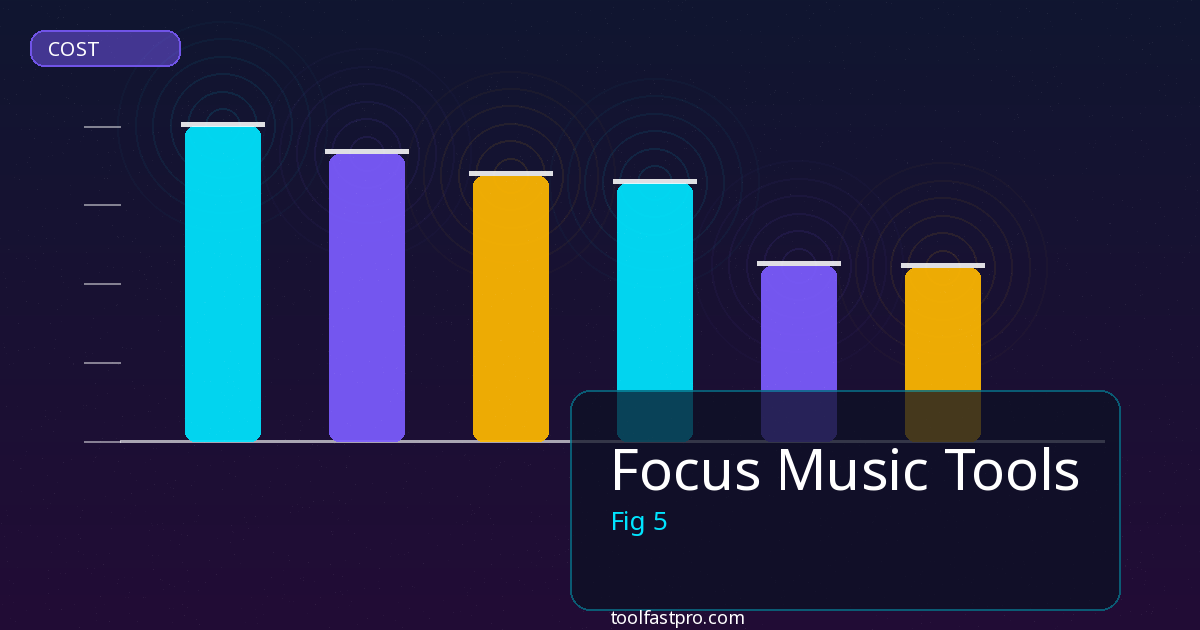
Three costs quietly accumulate with focus-music tools. First is the monthly subscription: apps like Brain.fm run around $6.95/month or ~$49/year, and Endel is ~$59.99/year, which adds up if you're already paying for Spotify. Second is curation effort — a raw playlist is only as good as the time you spend weeding out distracting tracks, and that time is real. Third is physical: hours of earbud or headphone use causes fatigue and, in some cases, ear discomfort, which no app fixes. The honest math is that for many people the free, stable, instrumental playlist plus a decent pair of headphones beats a paid "science" app. Spend money only when you've already exhausted the free fix and still can't stay consistent.
Comparison: The Main Focus-Music Tools, Priced Honestly
Here's a side-by-side look at six genuinely named options with their real free tiers and paid pricing, so you can match the cost to the attention problem.
| Platform / Tool | Key Feature | Price |
|---|---|---|
| Brain.fm | Generated audio matched to focus/relax/sleep states | $6.95/mo or ~$49/year; free trial |
| Endel | AI-generated soundscapes based on time, weather | ~$59.99/year; free tier limited |
| Spotify | Deep-focus and lo-fi playlists, huge catalog | Free (ads); Premium ~$11.99/mo |
| Lofi Girl (YouTube) | Steady 24/7 lo-fi radio stream | Free (ads) or YouTube Premium |
| Noisli | Mixable white noise and nature sounds | Free basic; Pro ~$1.99/mo |
| myNoise | Custom ambient generators, huge sound library | Free web; app one-time ~$6.99 |
The takeaway from the table: for pure external-noise masking, Noisli or myNoise is dramatically cheaper per hour than a streaming "focus" subscription. For a steady, hands-off ambient stream, Lofi Girl is free. Only pay for Brain.fm or Endel if you've tried the free routes and specifically want the adaptive, generated audio that these apps uniquely provide. For a broader look at apps that touch the whole focus stack, not just audio, the focus apps guide for 2026 rounds out the picture.
For more, check out: and focus apps.
For more, check out: .
FAQ: Focus Music Tools
Is it better to use white noise or actual focus music for programming?
For programming — language-heavy cognitive work — steady white/brown noise or instrumental usually beats focus music with lyrics. Programming requires verbal and logical working memory, so anything with vocals competes for those resources. If you need masking against office noise, brown noise explicitly is often cited by developers; if you need calm, a steady instrumental track works.
Can focus music actually hurt your concentration?
Yes, in specific cases. Music with lyrics during reading or writing measurably reduces comprehension. Music that is novel or emotionally captivating can hijack attention. And very fast-tempo music raises arousal in ways that impair sustained focus. The safest assumption: any audio that makes you want to sing along or that surprises you is hurting, not helping.
How long should I listen to focus music in a single session?
Match it to your natural attention spans — typically 45–90 minutes, followed by a short break. Listening continuously for hours both exhausts your ears and reduces the audio's helpful signal as it becomes noise. Most people get the best results from pairing a focus-music block with the same time-boxing you'd use for any deep work session.
Do noise-canceling headphones make focus music unnecessary?
Not entirely. Noise-canceling headphones eliminate external sound, which covers the external-noise problem. But if your struggle is internal distraction or you simply work better with steady audio, they don't replace the audio itself. Many people find the combination — good ANC headphones plus low-volume ambient — is the most reliable setup, because the ANC removes the physical layer and the audio soothes the mental one.
What's the most cost-effective focus-music setup for a beginner?
Start free: use a stable instrumental or lo-fi playlist on Spotify or Lofi Girl, and only add a white-noise tool (Noisli/myNoise) if you specifically need masking. Buy a decent pair of noise-canceling headphones before spending a penny on a "science" subscription. You can get 90% of the benefit this way, and you'll only upgrade to a paid app if the free route specifically falls short.
Music Is a Focusing Tool, Not a Focus Solution
The honest framing: focus music is a lever, and your attention habits are the fulcrum. No playlist fixes a calendar stuffed with interruptions, a phone that pings every 40 seconds, or a habit of multitasking through every block. The most durable result comes from combining the right audio — matched to your attention style and your task type — with the discipline to actually protect a focus window from the rest of the world. Treat audio as one more instrument in that setup rather than a magic switch, and you'll spend less money and get more focus. The playlists and guides can give you a head start on the curation, and the focus techniques guides will make sure the window actually stays protected. Good audio won't do the work for you, but it can quietly stop sabotaging it.