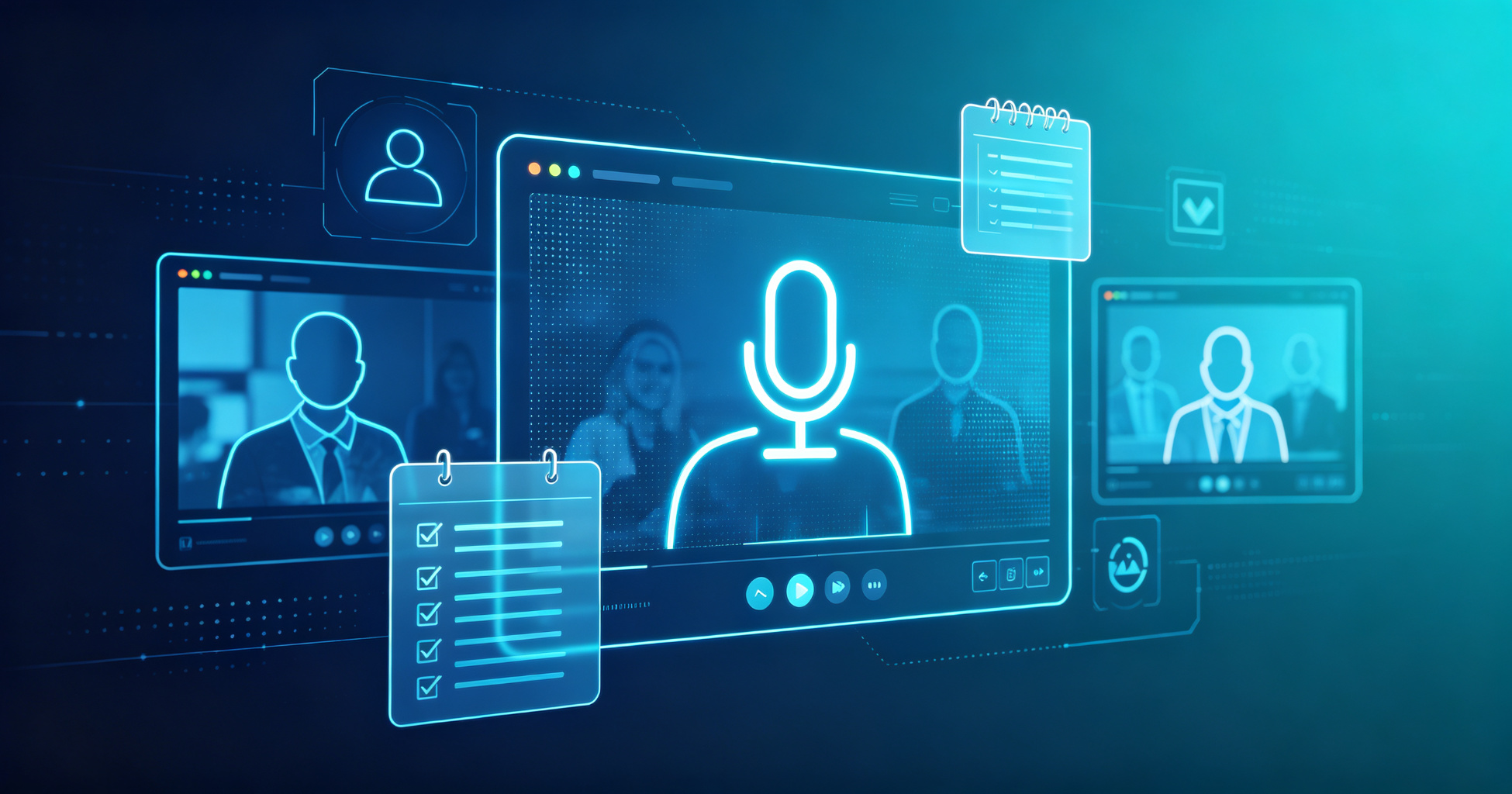
How AI Meeting Assistants Are Quietly Rescuing Your Calendar
The average professional attends roughly 62 meetings a month, with each one running about 43 minutes. Studies suggest nearly 30% of that time is effectively wasted on recaps, status updates, and decisions that could have been emailed. That is more than 11 hours every month dissolved into nothing. AI meeting assistants exist to win that time back—recording, transcribing, and summarizing conversations so you can focus on the actual work. This guide covers the real tools, the real prices, and the privacy traps you need to watch for.
What Exactly Does an AI Meeting Assistant Do?
An AI meeting assistant is software that joins your calendar and your virtual meetings to capture what happens. The good ones bundle five capabilities:
- Recording and transcription: They capture audio and turn it into searchable, timestamped text in near-real-time.
- Automatic summaries: They distill a 60-minute call into key decisions, action items, and owner names.
- Agenda preparation: Some generate a pre-meeting brief from past notes, docs, and the calendar invitation.
- Follow-up automation: They draft emails, assign tasks in your project tool, and send recaps to attendees.
- Search and recall: Later, you can find any phrase across months of meetings, not just the one you remember.
Tools now range from voice-only note-takers to full that execute post-meeting workflows end to end.
Why Transcription Alone Is No Longer Enough
A few years ago, getting a transcript felt like magic. But raw transcripts are long, unstructured, and hard to scan. The shift has moved to intelligence: extracting whether a decision was made, who owns the follow-up, and what the deadline is. Modern assistants classify turns, detect sentiment, and even flag risks. If you are comparing options, focus less on word-for-word accuracy and more on how well the summary maps to your daily workflow. This is where the real AI meeting summary tools differentiate themselves.
The Top AI Meeting Assistants Compared
Here is a reality-check table of the leading named tools as of this writing. Pricing changes often, so verify on each vendor's site before committing.
| Tool | Price | Core Features | Strongest Scenario | Weak Spot |
|---|---|---|---|---|
| Otter.ai | Free tier; Pro ~$16.99/mo | Live transcription, speaker labels, meeting summary | Individual journalists and students | Limited automation/integrations on lower plans |
| Fireflies.ai | Free tier; Pro ~$18/mo (annual) | Transcription, search, topic tracking, CRM sync | Sales teams wanting CRM logging | Audio quality drops in noisy rooms |
| MeetGeek | Free tier; Pro ~$19/mo | Auto-recording, action items, follow-up emails | Distributed teams running many client calls | Smaller ecosystem of connectors |
| Sembly AI | Free tier; Pro ~$20/mo | Team analytics, meeting intelligence, tasks | Managers reviewing team productivity | Team features require higher-priced plans |
| Claude (via integrations) | API / subscription based on usage | Custom summarization, agentic follow-ups | Teams needing tailored, high-quality summaries | Requires setup; not a turn-key recorder |
Beyond these, scheduling-focused bots live in a different bucket. If your pain is booking rather than note-taking, look at the AI scheduling assistants category.
How an AI Meeting Assistant Fits Around Your Real Workflow
Deployment usually follows a familiar pattern. You connect your calendar, grant access to a specific video-conferencing platform, and the bot joins as a silent participant. After the call it posts a recap to your in-box and your CRM or project manager. The value compounds when you set firm rules: only record when the topic column says client, always auto-assign action items to named owners, and send recaps only to attendees. Teams that treat the assistant as a disciplined teammate, rather than a black box, see the largest gains.
The Hidden Costs and Privacy Traps
Free tiers sound generous until you read the fine print. Several popular services retain your audio and transcripts on their servers for model improvement, sometimes with ambiguous opt-out clauses. Before you adopt any tool, check whether it supports enterprise data-residency, on-device processing, or a signed data-processing agreement. Also confirm the platform lets you delete recordings permanently and that the free plan does not quietly downgrade you after a 14-day trial. Sensitive topics such as M&A, hiring, and salary are exactly where a careless assistant leaks trouble.
Choosing the Right Assistant for Your Team
Start with the cheapest plan that covers your primary use case, then scale. A solo consultant may do fine on Otter or Fireflies; a sales-heavy company often prefers Fireflies for CRM logging or MeetGeek for automated follow-ups; an engineering team that wants bespoke summaries might wire Claude into a custom pipeline. Price per seat matters, but so does the cost of your attention—do not trade a longer integration setup for ten dollars a month. Re-examine your choice quarterly as features evolve and pricing shifts.
For more, check out: .
For more, check out: , meeting notes ai and ai writing assistants 2026.
FAQ
Do AI meeting assistants record the meeting automatically?
Most do once connected to your calendar and video platform. The bot joins silently and begins transcription on schedule. Always check that attendees are notified, because some regions require consent to record.
Are free plans of meeting assistants actually usable?
Yes, but with limits. Free tiers typically cap recording minutes per month (for example three meetings and 1,200 minutes monthly), restrict transcript storage, and drop advanced integrations. They are great for evaluation but often too constrained for daily team use.
Can the transcript be exported to Notion, Slack, or Salesforce?
Yes. Fireflies, MeetGeek, and Sembly offer native integrations with Slack, Notion, Google Drive, and major CRMs. Confirm your specific tool supports the destination you use before subscribing.
What happens to my recordings from a privacy standpoint?
Providers store audio and transcripts on their cloud infrastructure. Check settings for auto-delete policies, opt-out of training data, and enterprise data-processing agreements. Never record sensitive negotiations without explicit consent.
Can AI meeting assistants generate follow-up emails automatically?
Most premium plans draft recap emails and action items you can review and send. A few, particularly those built around , can even push tasks straight into your project management tool.
Which assistant gives the most accurate record of a noisy call?
Accuracy varies, but Fireflies and MeetGeek generally handle moderate background noise best with speaker diarization. For consistently poor audio, use a high-quality headset and enable the platform's built-in noise suppression first.
❓ Frequently Asked Questions
How AI Meeting Assistants Are Quietly Rescuing Your Calendar
The average professional attends roughly 62 meetings a month, with each one running about 43 minutes. Studies suggest nearly 30% of that time is effectively wasted on recaps, status updates, and decisions that could have been emailed. That is more than 11 hours every month dissolved into nothing. AI
What Exactly Does an AI Meeting Assistant Do?
An AI meeting assistant is software that joins your calendar and your virtual meetings to capture what happens. The good ones bundle five capabilities:
Why Transcription Alone Is No Longer Enough
A few years ago, getting a transcript felt like magic. But raw transcripts are long, unstructured, and hard to scan. The shift has moved to intelligence: extracting whether a decision was made, who owns the follow-up, and what the deadline is. Modern assistants classify turns, detect sentiment, and
The Top AI Meeting Assistants Compared
Here is a reality-check table of the leading named tools as of this writing. Pricing changes often, so verify on each vendor's site before committing.